Alexander Sokolov
Born 1991 / Crimea
Images for STOP LOOK GO taken in Berlin / 2020–2023
Gregor: How did you get into analogue photography?
Alexander: In 2020 friends got me an analogue cameras a birthday present. But I had already been taking photos for quite a long time before that - first with a digital camera, and later also a lot with my phone. My background was not originally photography. I studied law and worked in that field for a while. When I came to Berlin in 2015, I started working more as a graphic designer, and photography slowly became part of that professional context as well. At the beginning, analogue photography was not that easy for me. There were suddenly so many things to understand: ISO, film stock, lenses, exposure, the whole process. Luckily, there are a lot of good tutorials on YouTube, so I started learning from there. Then the pandemic happened, and I had a lot of time. I also felt that I needed to give myself some kind of task, something to focus on. So I started going for long walks through Berlin with a camera. That was really the moment when I got properly into analogue photography. Later I bought a Canon AE-1 Program from the 80s, and since then I have been shooting analogue almost every day.
Gregor: Where does the fascination for analogue photography come from?
Alexander: You can see that analogue photography has become popular again just by looking at the prices of old cameras. They have gone up a lot. I think for many people of my generation, there is also a kind of nostalgia in it. The images remind us of a time that we live through, or maybe only remember from family photos, old magazines, films, and music culture. There is something about the grain, the softer colours, the blur, the imperfections. It feels more physical somehow. That is one of the things I like about it. It is not just an image on a screen. There is actual material involved. Light touches the film, and the image is built inside it. Depending on the length of the waves, the light exposes different layers in the celluloid, one of the primary colours at a time. This causes the particles to darken and stack up in layers, creating a depth effect. The silver particles that expand on contact with light create the grain. Different film stocks react differently to this process. Some are sharper and cleaner, some are softer, some have more visible grain or stronger colour shifts. Different manufacturers have their own character, and after a while you start to recognise that. So for me, analogue photography is a mix of feeling and technical process. You choose the camera, the lens, the film stock, the light, and later the scan or the print. All of these things affect the final image. You can control some of it, but not everything — and that is part of why it stays interesting. But I am still learning too. I don’t want to pretend I know everything. For anyone who wants to go deeper into the technical side, I would recommend Fotoimpex. They are just around the corner from Kaffeemitte, on Alte Schönhauser Straße, and they really know analogue film stock.
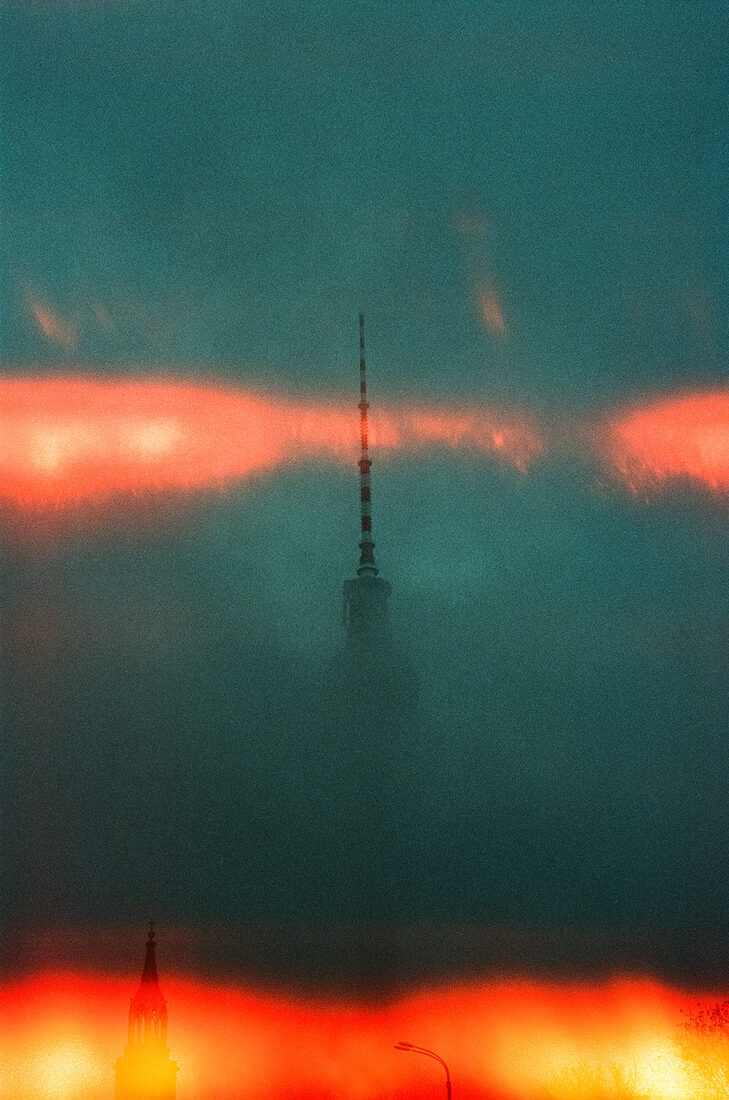
„TV Tower“
I took this picture during one of those long grey periods in Berlin, when the sky feels low and the city stays dark for weeks. For the exhibition, this was the first image I chose. It stands for Berlin to me — not only because of the TV Tower, but also because of the weather. I have photographed the tower many times, but I am only really happy with a few of those pictures. When I got the scans from this roll, the light leaks were a positive surprise. They made the image feel complete. The orange and red parts were technically a mistake, but they gave warmth to the grey landscape. That is something I like about analogue photography. Sometimes the “wrong” handling gives you the better result. Light leaks can happen when film is loaded and a bit of light reaches the first part of the roll. Usually you are meant to take one or two blank shots before you start, exactly to avoid that. But here, that accident became the thing that makes the picture work. The film was also not really meant for daylight. It was tungsten film, balanced for artificial light. When you use it outside, the colours shift, and you get these blue and red tones. In this case, that worked perfectly for the image.
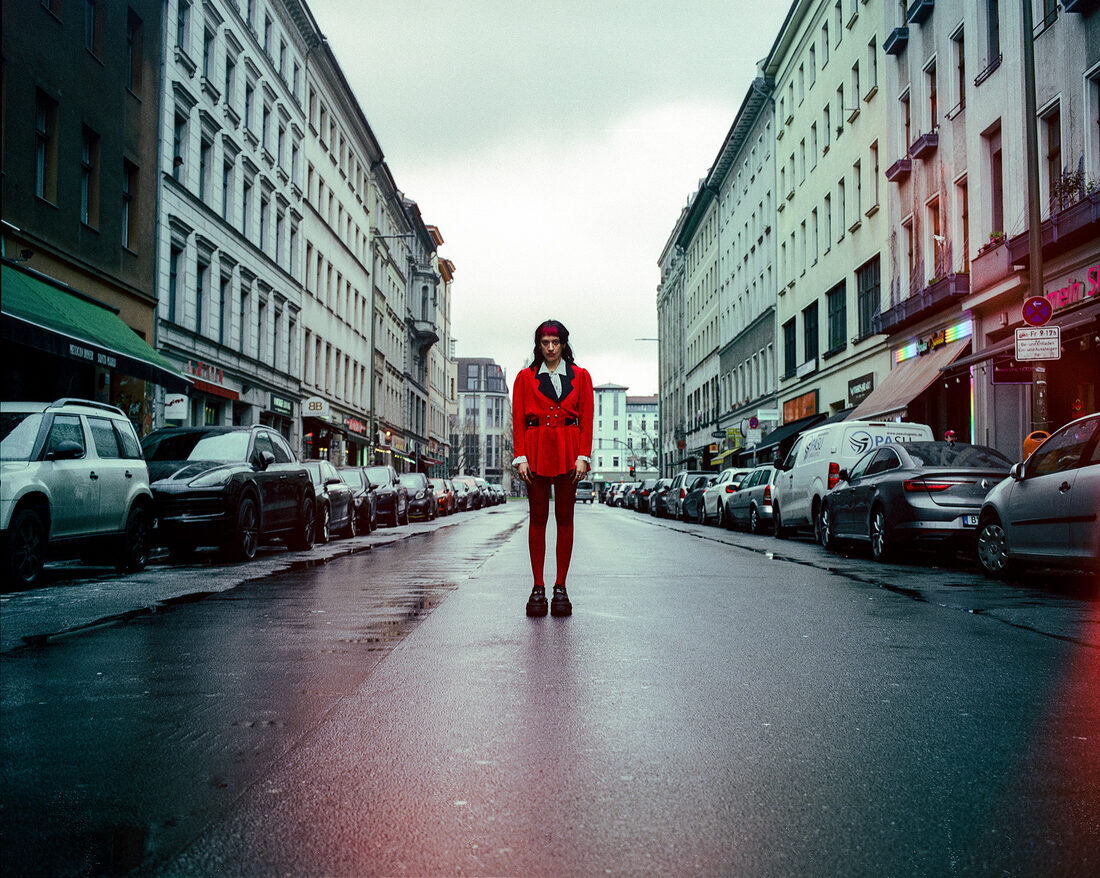
„Izlem“
I took this picture with a medium-format camera. The negative has a 6:7 format, which worked well for this image because the person is standing upright in the centre of the frame. This was a quick choice for the exhibition. It connected well with the other picture with the tower — both have this strong vertical figure in the middle. Here it is a person, standing in an empty Berlin street in winter. I liked the contrast between the grey city and the red clothes. The street feels quite cold and quiet, but the red gives the image focus and energy. I also dedicated this picture to Café Luzia on Oranienstraße. I went there often, and over time it became one of my favourite places in Berlin. I met many like-minded people there, and a lot of conversations and opportunities came from that place. Through people I met there, I was later invited to photograph Berlin Fashion Week and the Berlinale. So for me, the image is also connected to that period of Berlin life — meeting people, finding work, and slowly building a place for myself in the city.

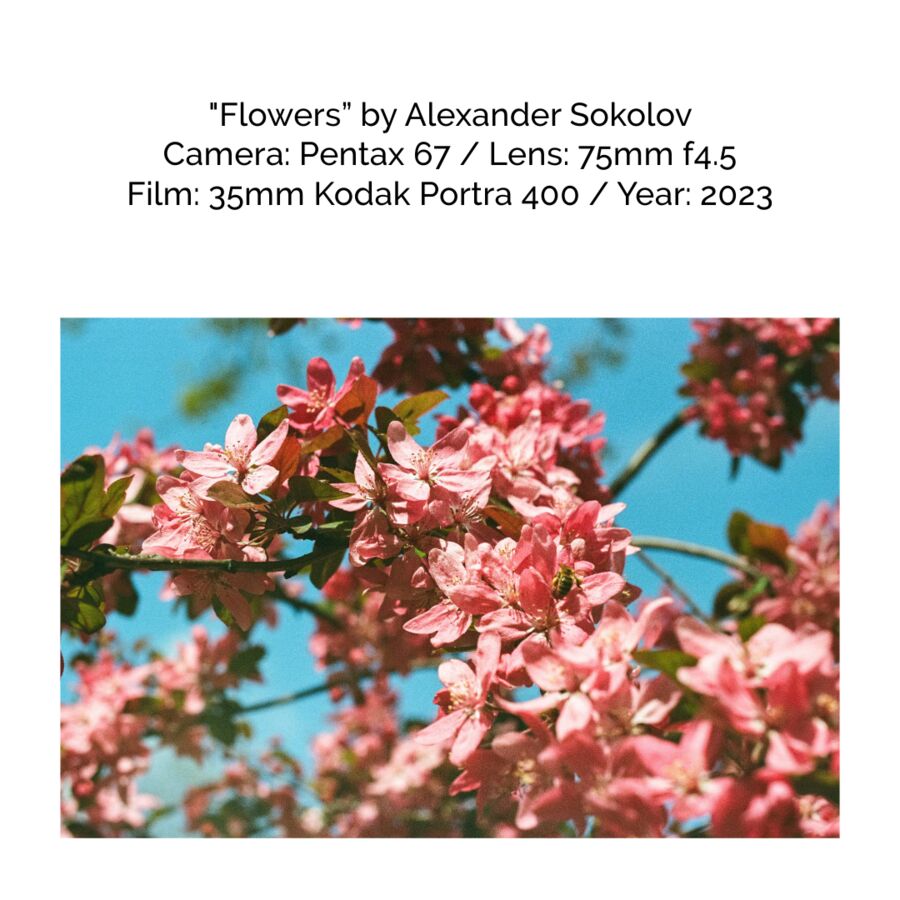
„Sakura“
There are quite a lot of cherry trees in Berlin, and for a few days every year the city has this small Sakura moment. It is not exactly Japan, of course, but suddenly these streets and parks change completely. Everything becomes softer, lighter, more colourful. I remember being really happy about the spring sun. I was walking around and taking a lot of photos, partly because the light was doing exactly what you want it to do. With sunlight, the colours just come alive. Especially on film, it has this different kind of richness. I shot this picture on a Pentax 67, which is a medium format camera. Normally you use 120 film with it, but here I used 35mm film instead. Technically, you are using the material in the “wrong” way, but that is also what makes analogue photography interesting. You can bend the process a little and see what happens. When you put 35mm film into a medium format camera, you can expose the whole roll, including the sprocket holes — the small perforations on the edge of the film. That result is often called sprocket hole photography. It shows the full physical object of the film, not just the clean image area. But for the exhibition, I decided to crop the sprockets out. In this case, I did not want the technical trick to become the main subject. I wanted the flowers to stay the focus. The beauty of the image was more important than showing the process behind it. That is also something I like about analogue photography. There are so many choices, and the final image is not only decided when you press the shutter. It continues later — when the negative is scanned, cropped, printed, or interpreted by the lab. Sometimes the limits come from the camera, sometimes from the film, sometimes from the scan. At some point I would like to scan the negatives myself, because then I can control that part of the process more closely. And I would also like to develop black-and-white film at home. That feels like the real thing to me: being closer to the material, not just the final image.
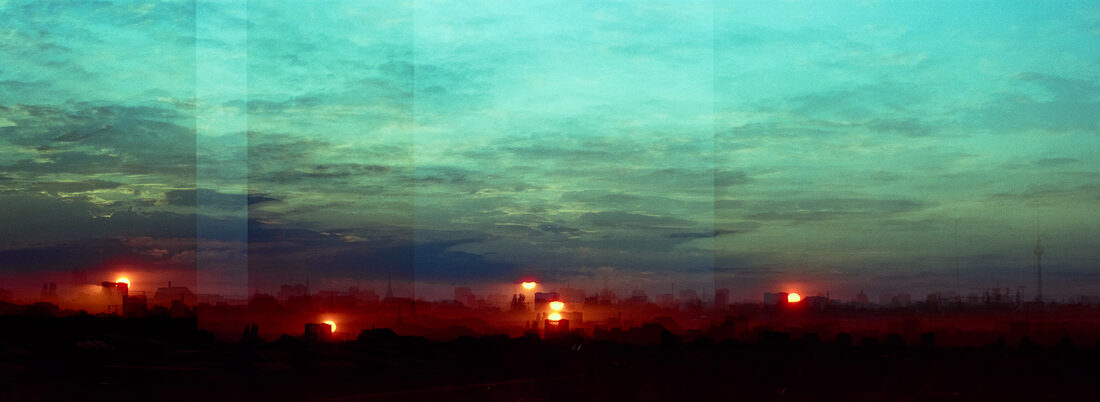
„Berlin’ Suns“
I took this photo from a car park in Neukölln, close to Klunkerkranich. Usually, you would go up to the rooftop, but at that time, the bar was closed because of lockdown, so I couldn’t get there. Instead, I walked through this empty car park and used the balustrade as a kind of stand. I checked the exposure with an app — I think it came out to around 12 seconds for each frame. But with film, especially in that kind of situation, it is never completely exact. The light conditions are changing fast. You calculate, you guess a little, and then you trust it. During the Corona period, it was not always easy to stay balanced. Walking through Berlin became a way for me to deal with that. I would cross different districts with my camera, without a real plan or fixed route, just looking for something that would catch my attention. It became almost like an exercise: to drift, to observe, to stay present. Photography helped me sharpen my senses, but also to let go a bit. I started to accept that I am not in control of everything. This picture is a good example of that. A lot of photography is preparation, but a good picture is also luck. Maybe 60% luck. You have to be there, you have to notice it, but you also have to accept what happens. That was a valuable lesson for me. I learned to let go of perfectionism. Digital photography often wants everything to be perfect. Film doesn’t work like that — and I don’t really want it to.