
Anselm Hirschhäuser
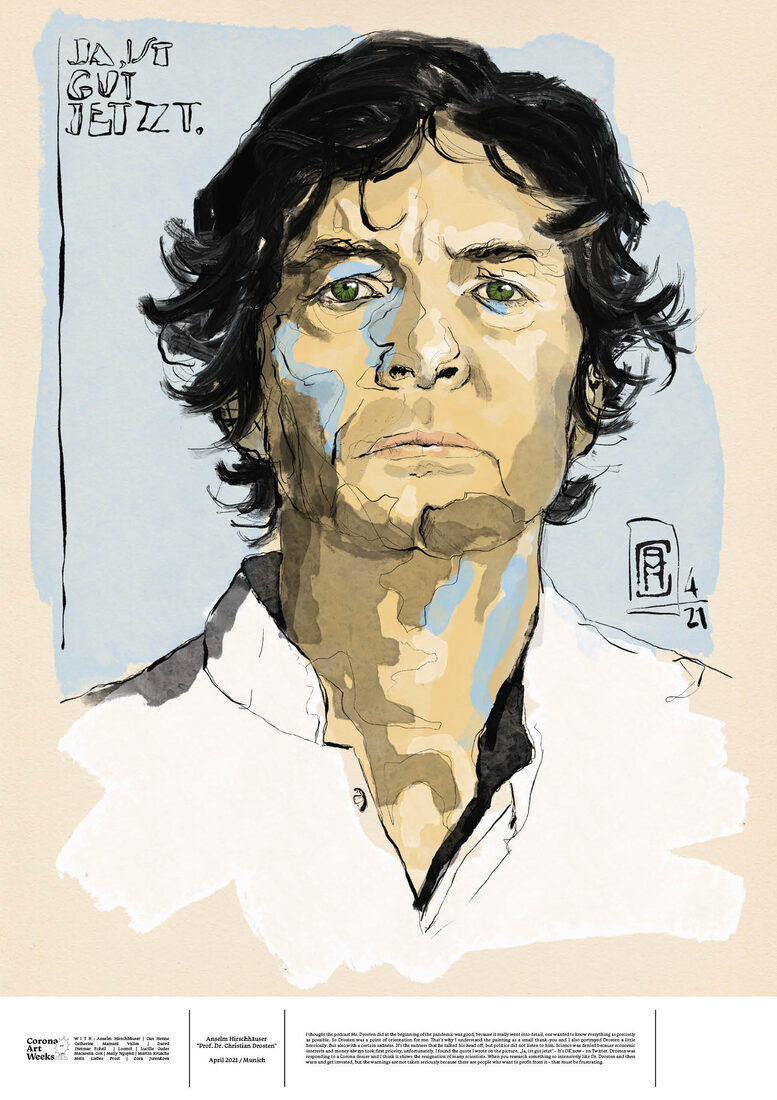
I thought the podcast Mr. Drosten did at the beginning of the pandemic was good, because it really went into detail, one wanted to know everything as precisely as possible. So Drosten was a point of orientation for me. That’s why I understand the painting as a small thank-you and I also portrayed Drosten a little heroically. But also with a certain sadness. It’s the sadness that he talked his head off, but politics did not listen to him. Science was denied because economic interests and money always took first priority, unfortunately. I found the quote I wrote on the picture, „Ja, ist gut jetzt“ — It’s OK now — on Twitter. Drosten was responding to a Corona denier and I think it shows the resignation of many scientists. When you research something so intensively like Dr. Drosten and then warn and get invested, but the warnings are not taken seriously because there are people who want to profit from it — that must be frustrating.





When I first saw the picture by Anselm Hirschhäuser online, it provoked me in a certain way. Such an explicit glorification of Dr. Christian Drosten seemed inappropriate to me — at a time when I have personally tried to avoid too clear a commitment to individual persons and positions. But the reference to the group show Corona Art Weeks was simply too obvious and the aesthetic and artistic quality out of question. So I spoke to Anselm Hirschhäuser and learned that the motivation for the painting was the wish to say thank you. Even though Dr. Drosten is not a particularly important figure for me, I find a thank-you a positive, lovely gesture — one that I can stand behind regardless of any worldview standpoint.
I also find it brave of Anselm Hirschhäuser to take such a clear position. Especially in a context — the internet — in which Dr. Drosten is subject to much criticism, it is courageous to make such an artistic statement. Risky art is far too rare — so for me this painting stands for the courage to make a clear statement and to make oneself vulnerable.
What surprised me was Anselm’s statement that he portrayed Dr. Drosten as somewhat cringing because politics didn’t listen to him. The economy, capitalism rules the world — which is why Dr. Drosten could not get his way with his demands. Until then, I knew the argument the other way round: since capitalism rules, the big companies get billions, the rich get richer and the poor get poorer. Dr. Drosten is thus becoming an identification figure for either the good side or the bad side. In both cases, however, it is capitalism, the economy, that is identified as the cause of the problems. Dr. Drosten is sometimes capitalism’s henchman, sometimes its victim.